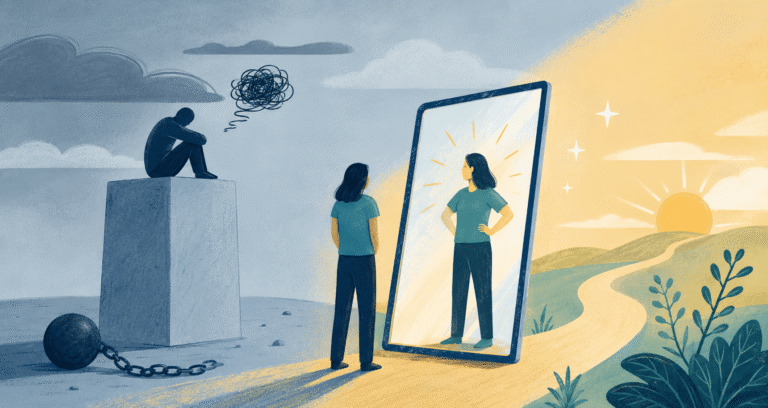
How to Stop Comparing Yourself on Social Media: 7 Tips
Jun 7, 2026You open Instagram to “just take a quick peek.”
Five minutes later, you put the phone down feeling strangely smaller.
Someone’s vacation. Another person’s body. The picture-perfect couple. The promotion you didn’t get. And, in the middle of it all, that nagging little question: why does everyone’s life look better than mine?
If this happens to you, rest assured you’re not alone — and it’s not a personal weakness. In fact, it’s exactly how these platforms are built to work.
In this article, then, you’ll understand why comparison on social media hurts so much. More importantly, you’ll walk away with practical strategies to stop measuring your life against everyone else’s.
Why does comparing yourself on social media hurt so much?
The answer, honestly, is simpler than it seems.
Basically, you compare your entire life to the best little sliver of everyone else’s.
Think about it. You know your own behind-the-scenes: the overdue bills, last night’s argument, the bedhead on a Monday morning, the boredom of a random Wednesday.
On the other side of the screen, however, you only see the highlight reel. In other words, the moment hand-picked, well-lit, perfectly angled, and run through three filters.
It’s not a fair fight. After all, it’s your full reality up against someone’s edited trailer.
You’re comparing your reality to other people’s highlights
Nobody posts the overdraft notice.
Likewise, no one shares a story of the day they stayed in bed until three in the afternoon with zero energy for anything.
The feed, deep down, is a storefront window. And a window, as we know, only displays what sells.
When you forget that, then, you start believing other people’s lives are just that: travel, parties, wins, smiles. As if the backstage didn’t exist.
But it does. You simply don’t see it.
Your brain wasn’t built for 500 “perfect lives” a day
Comparing is part of being human. We’ve always done it, after all.
For thousands of years, we looked at a few dozen people in our tribe and gauged where we stood. It was useful. After all, it helped us learn, cooperate, and survive.
Back then, though, it happened on a small scale.
Today, by contrast, you scroll past hundreds of carefully staged “lives” before your coffee even gets cold. Influencers, acquaintances, strangers, brands.
Your brain, however, has no off-switch for comparison. It simply wasn’t designed for that volume. So it does the only thing it knows how to do: it puts you, again and again, in last place.
What comparison does to your self-esteem
Chronic comparison, over time, leaves a mark.
Little by little, it plants a quiet, stubborn idea in your head: I’m not good enough.
Not attractive enough. Nor successful enough. Much less interesting, fit, productive, or likable enough.
That “never enough” feeling, interestingly, has a name. Researcher Brené Brown calls it the culture of scarcity — in other words, the constantly reinforced belief that we’re always falling short of something.
Comparison, in this picture, is one of the biggest fuels for that culture. The more you measure yourself against someone else’s yardstick, the deeper that sense of lack settles in.
And here’s the worst part: it’s a bottomless pit. After all, there will always be someone with more. More followers, more travel, more muscle, more apparent luck. So the bar never stops rising.
The good news? You can step out of this game. Here’s how.
How to stop comparing yourself on social media: 7 strategies
First of all, none of this requires you to delete everything and move to a cabin in the woods.
On the contrary, these are practical tweaks you can start applying today.
1. Do a feed cleanup
First, notice how you feel after seeing certain accounts.
Some inspire you. Others, though, drag you down every single time.
There’s nothing wrong with muting or unfollowing whoever triggers that pang of envy or inadequacy. It’s not bitterness. It’s mental hygiene.
In return, fill your feed with what nourishes you: learning, humor, real people, things that actually feel good.
In the end, your feed is a diet. And you choose what you eat.
2. Swap comparison for curiosity
When that “why am I not like that?” hits, try changing the question.
Instead, experiment with: what can I learn from this?
Comparison pushes you down. Curiosity, on the other hand, moves you forward.
One turns someone else’s success into a personal attack. The other, meanwhile, turns it into a clue, an example, a possibility.
Same scene, therefore, a completely different reaction.
3. Remember that a post isn’t a life
Try building a new reflex.
That way, every time a post stings, ask yourself: what got left out of this photo?
The dream-vacation photo, for example, doesn’t show the meltdown at the airport or the credit card bill.
The perfect body, meanwhile, doesn’t show the grueling routine, the genetics, or sometimes the Photoshop.
This isn’t about rooting for anyone to fail. Rather, it’s about remembering you’re seeing one frame, not the whole story.
4. Identify your triggers and set limits
To start, pay attention to when you scroll.
There are times when comparison hits harder: when you’re tired, lonely, bored, or lying awake before bed.
Identify those moments, because they’re your triggers.
Then, build small barriers. For instance, keep the phone out of the bedroom at night, turn off a few notifications, and set a screen-time limit you’ll actually respect.
In other words, you don’t need infinite willpower. Instead, you need fewer chances to fall into the trap.
5. Practice gratitude for what’s yours
Comparison always points to what’s missing.
Gratitude, by contrast, does the opposite: it points to what you already have.
It doesn’t need to be complicated. Every night, for example, jot down three good things from your day. It could be a great cup of coffee, a conversation, a small win.
It sounds silly, I know. But over time, it retrains the way you see.
Little by little, then, your attention drifts back to your own life — instead of staying glued to everyone else’s.
6. Share with more honesty
Here, by the way, there’s an interesting twist.
The more real you post, the less pressure you feel.
After all, when you show only the highlight reel, you join the very appearance race that hurts you. And you fuel that race for others, too.
Posting with a little more truth — the ordinary day, the mistake, the process, not just the result — eases you and, at the same time, gives others permission to breathe too.
In short, authenticity breaks the cycle. Yours included.
7. Build self-esteem offline
This one, without a doubt, is the foundation of it all.
After all, if your worth depends on likes, it’ll always wobble with the feed.
So build self-worth where it’s solid: in your real relationships, in what you create, in your body in motion, in the things that give you purpose.
That way, the fuller your life off the screen, the less power the feed holds over you.
Comparison, then, loses its grip when you have something to stand on.
The courage to show who you really are
Deep down, comparison is a way of dodging vulnerability.
After all, we edit, filter, and hide precisely because we’re afraid of not being accepted as we are.
But that’s exactly where the way out lives.
Brené Brown spent years studying this and reached a powerful conclusion: vulnerability isn’t weakness. On the contrary, it’s courage. It’s the courage to show up whole, flaws and all, without the armor of a flawless image.
So when you let go of looking perfect, you stop competing in a race no one ever wins.
That’s what she writes about in Daring Greatly — in other words, an invitation to trade the exhausting hunt for approval for the freedom of being who you are.
So, if this topic struck a chord, it’s worth exploring the idea further. Take a look at our [summary of Daring Greatly] and our [article on the scarcity formula], where comparison shows up as one of the three pieces of that mechanism.
Frequently asked questions (FAQ)
Do I have to delete social media to stop comparing myself? Not necessarily. For most people, the problem isn’t the platform itself — it’s uncontrolled use. So a feed cleanup, clear limits, and a more mindful relationship usually do the trick. Deleting, in the end, is an option, not a requirement.
How long does it take to stop comparing yourself? There’s no exact timeline. After all, comparison is a mental habit, and habits change with repetition. Some changes, like cleaning your feed, bring almost instant relief. Others, however, like retraining how you see, take weeks. What really matters is consistency.
Is comparing yourself always bad? No. In fact, comparison can inspire and teach when it turns into curiosity. The real problem is chronic, destructive comparison — the kind that only tells you you’re not enough. So the goal isn’t to never compare; it’s to stop measuring yourself by other people’s yardsticks.
How can I help someone who compares themselves too much online? Avoid brushing it off with lines like “that’s silly.” Instead, help the person notice how they feel after using their phone. On top of that, gently suggest a feed cleanup and, above all, set the example by posting and living with more honesty.
Your life doesn’t fit in a feed
Social media comparison, at the end of the day, will always hand you an edited version of other people’s lives and charge you against your unedited one.
In other words, the game is rigged. And you don’t have to play.
Learning how to stop comparing yourself on social media, then, isn’t about becoming numb. It’s about reminding yourself, every single day, that what’s on the screen is one frame — and that your real life, ups and downs included, is worth infinitely more than any post.
Your life doesn’t fit in a feed. Thank goodness for that.
Finally, if you want to go deeper on this path of accepting yourself as you are, start with our [summary of Daring Greatly]. It might be the nudge you’ve been waiting for.