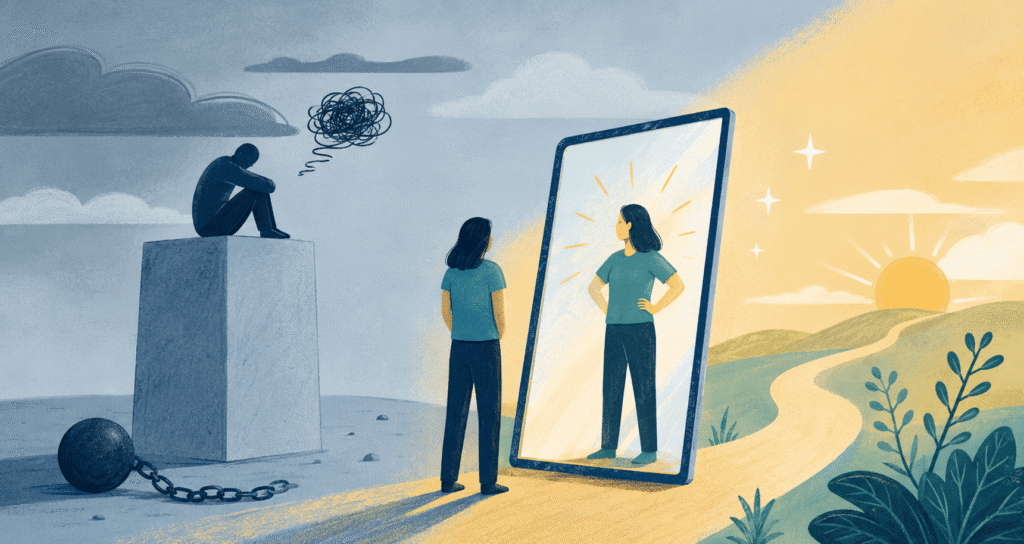
Why You Never Feel Good Enough (and How to Break the Cycle)
Jun 7, 2026Your eyes open in the morning and the first thought already weighs you down.
“I didn’t get enough sleep.”
Then the second one lands: “There’s no way I’ll get everything done today.”
Before your feet even hit the floor, you feel behind. In the red. Missing something you can’t quite name.
If that sounds familiar, then know that you’re not alone. This is the feeling of never being good enough. And it has a cruel trick: it shows up even when, on paper, everything is fine.
You land the promotion but chalk it up to luck. Later, you get the compliment and figure they were just being nice. Finally, you finish a productive day and still go to bed feeling like you could have done more.
In this guide, you’ll learn where that voice comes from. And, more importantly, you’ll also learn how to interrupt the pattern. No magic formulas, just real steps you can start using today.
What is this feeling of not being good enough, really?
It’s not a bad day. After all, everyone has bad days.
But this is different. It’s a background voice, almost constant, whispering that you still haven’t arrived. That something is missing. That other people have more, know more, are worth more.
A bad day passes. This feeling, however, doesn’t. Instead, it becomes the backdrop of your life.
And here’s the part that confuses so many people: it doesn’t depend on the facts. In other words, your life can be in great shape and you’ll still feel like you’re falling short. That happens because the problem isn’t out there. Rather, it’s in the ruler you use to measure yourself.
Researcher Brené Brown calls this cultural pattern scarcity. In short, it’s the chronic sense of never being or having enough. And it doesn’t just live in your head. On the contrary, it’s in the air we breathe.
Why do I never feel enough, even when things are going well?
Because the scarcity mind doesn’t count what you have. Instead, it counts what’s missing.
Think about how much of your day runs on this. How much more you still need to earn. How many pounds you still want to lose. How many more followers everyone else seems to have. How little time you got.
It’s a tally that never lands in the black. In fact, there’s always one column in the red.
And worse: that math runs on autopilot. As a result, you don’t even notice you’re doing it. The “not enough” thought arrives before any reflection. Little by little, it becomes a mental habit.
That’s why success doesn’t fix it. After all, you change the numbers, but the ruler stays the same.
The invisible ruler of comparison
This is where a lot of the problem lives.
You don’t compare your real life to other people’s real lives. Instead, you compare your full version, with all the behind-the-scenes and frustration, to the edited version everyone else puts on display.
Social media supercharges this. For example, you see the result, never the effort. You see the vacation, but not the credit card bill. You see the body in the photo, yet not the hundred shots that got deleted.
And there’s an even sneakier comparison: nostalgia.
Notice how often you compare the present to a past your memory has edited. “Those were the good old days.” Except those days, in the perfect way you remember them, probably never existed. After all, nostalgia sanded down the rough edges.
Comparison is normal. However, the problem is comparing yourself to a ruler no one can reach, because it’s made of fiction.
More won’t cure not-enough
Here’s an idea that sets you free.
A lot of people try to silence the feeling of lack with more. More work, more shopping, more wins, more recognition.
But excess and scarcity are two sides of the same coin. In other words, both come from the same place: the belief that what you are, right now, isn’t enough.
Piling on more doesn’t fill the hole. In practice, it just covers it for a while. Soon the voice comes back, asking for the next rung.
Therefore, the opposite of scarcity isn’t having a lot. It’s having enough. Put another way, it’s the sense that you, today, are already enough.
Where does this voice that says you’re not enough come from?
It wasn’t born with you. Rather, it was learned.
Brené Brown identifies three ingredients that, together, manufacture this feeling in any environment. So it’s worth looking at your family, your job, your school, your feeds.
The first is shame. It happens when fear of looking foolish is used to keep people in line. It shows up when your worth seems tied to your performance. It appears when making a mistake turns into humiliation.
The second is comparison. It grows when there’s competition all the time, spoken or unspoken. It also surfaces when there’s one “right” way to be, and anyone who doesn’t fit feels like an outsider.
The third is disengagement. It takes over when it’s safer to stay quiet than to speak up. It weighs on you when it feels like no one is really paying attention. It grows when everyone is fighting just to be seen.
Put the three together and you’ve got the perfect soil. As a result, scarcity grows in it and spreads. It moves from society to the company, from the company to the home, from the home into your own head.
The good news is that learned patterns can be unlearned.
The 3 signs you’ve fallen into the scarcity trap
Before you can change it, you have to spot it. So see if any of these signs feel familiar.
- You feel overexposed when you slip up. A small mistake turns into an internal spiral. You replay the scene, imagine everyone judging you, and dread looking like a failure.
- You’re constantly measuring yourself against others. You can’t celebrate a win without checking whether someone else won bigger. As a result, the outside ruler weighs more than your own satisfaction.
- You avoid risk to avoid exposure. You hold back from trying, from speaking, from sharing an idea. Deep down, you’d rather stay safely quiet than risk not being good enough.
Recognize one, two, or all three? That’s okay. In fact, recognizing it is the start of the way out.
How to break the cycle: 5 practical steps
Scarcity is a mental habit. And habits change with practice, not with willpower alone. So here’s where to start.
1. Name the automatic thought. Next time the voice says “not enough,” pause and name it. “Oh, that’s scarcity again.” That way, naming creates distance. You stop being the thought and start observing it.
2. Question the ruler, not yourself. When you feel behind, ask: behind whom? Compared to what standard? You’ll often realize you’re measuring your real life against an edited fiction. In other words, the ruler is wrong, not you.
3. Trade comparison for contribution. Instead of “who’s ahead?” ask “what can I offer here?” After all, comparison isolates you, but contribution connects you. And connection is the direct antidote to scarcity.
4. Practice vulnerability in small doses. You don’t have to expose yourself to the world all at once. So start small. Share an idea in a meeting. Admit you don’t know something. Ask for help. That way, each small act of courage weakens the fear.
5. Define what “enough” means for you. Without it, the ruler never stops rising. So choose. What’s enough this month, this project, this week? When you define enough, you take back control of the ruler.
None of these steps demand perfection. Instead, they demand repetition. A little today, a little tomorrow.
Vulnerability isn’t weakness (it’s the way out)
Maybe you read “vulnerability” and winced.
Most people associate the word with fragility, with dropping your guard, with being exposed. However, it’s the opposite.
Vulnerability is having the courage to show up without any guarantees. In other words, it’s risking, trying, putting yourself out there, knowing it might not work out, and doing it anyway.
It’s the exact opposite of scarcity. While scarcity says “hide, you’re not enough,” vulnerability says “show up, you’re already enough.”
Brené Brown calls this state wholeheartedness. Yet it’s not arrogance. Nor is it thinking you’re better than anyone. Rather, it’s simply putting down a debt that was never real.
It’s waking up in the morning and, before your feet hit the floor, no longer feeling like you’re falling short.
Frequently asked questions
What’s the difference between wanting to improve and never feeling enough? Wanting to improve starts from a place of acceptance: “I’m okay and I want to grow.” Scarcity, on the other hand, starts from lack: “I’m not good enough, so I have to keep running.” The first one motivates you. The second one, meanwhile, wears you down.
Is this feeling the same as low self-esteem? They’re close, but not identical. Low self-esteem is a judgment about yourself. The scarcity feeling, however, is broader: it’s a lens that makes everything seem insufficient, including you. If it persists, therefore, it’s worth seeking support from a professional.
Does social media cause this feeling? Not on its own, but it amplifies it a lot. After all, it feeds comparison against edited versions of other people’s lives, which strengthens the sense of always being behind.
What can I read to go deeper on this? Daring Greatly, by Brené Brown, is the ideal entry point. Throughout its pages, the book digs into the culture of scarcity and shows how vulnerability opens the path to a more wholehearted life.
Conclusion
The feeling of not being good enough isn’t a flaw in you. On the contrary, it’s a learned pattern, fed by a culture that’s always counting what’s missing.
The good news is that patterns can be interrupted. When you name the voice of scarcity, question the ruler, and practice the courage to show up, something shifts. As a result, little by little, enough stops being a distant goal and becomes a place you already stand.
If you want to understand that shift from the inside, then the next step is to explore the book these ideas came from. Check out our summary of Daring Greatly, by Brené Brown, and discover how vulnerability can be the way back to wholeheartedness.